
Unglamorous Writing Tasks
Otherwise Known as Research and Submissions

There is a side to being a writer that encompasses what I define as unglamorous work: the researching of poetry journals and chapbook presses and seeing if your work is a good fit for their mission, as well as keeping track of submissions. And depending on what you write and how your brain works, different strategies work for different writers.
When I first started sending my writing out, I wanted a rule book for how things were “supposed to work.” The truth, which I didn’t recognize at the time, is that these processes work differently for different genres and different people. While that is a general truth, it is also true that what might work well for one writer could work well for another or at least give them a jumping off point to begin figuring out what could better work for them. With that in mind, I’d like to offer support in the best way I know how, by sharing what has worked for me.
A poet friend of mine and I were talking last week about what feels like the arbitrary-ness of being published; it’s true, we can’t read editor’s minds. But I find if I read several back issues of a journal and/or their mission statement, I can locate a rough idea of their aesthetic and then I glance through my poems to see if mine have a similar bent. Sometimes there are three or four which I think could fit. Sometimes the journal doesn’t appeal to me. Other times I am inspired by what I read and even though I haven’t written anything yet that fits the aesthetic, I am willing to try to expand my writing breadth and try to come up with a few poems which might interest the journal’s editors. If I think the journal could be a fit for me, I simply bookmark that journal’s submission page on my computer and make a note of when they are open for submissions. I only submit to journals which do not charge a fee. If someone wants to support a particular journal that charges a fee, that’s great. Like anything to do with money, I think it’s a very subjective decision.
Poet Nolcha Fox has a great video that talks about submitting poetry—the reasons and expectations. Check it out: Garden of Neuro Presents: Poetry Submission Strategies with Poet & Editor Nolcha Fox on You Tube.
Personally, I want to be published. What I mean when I say that is:
I want all the people who can read
to read all of the poems
I write.
And when I gather enough,
I want my poems
to be organized in a chapbook
to be launched into the world
so, even more people can read them.
I want my poems to inspire, make people think, foster curiosity and give voice and validation to anyone whose lives they touch. So, I submit A LOT. I have a list of over 200 poetry journals—traditional and online—I submit to on a yearly basis. Last month, for September, I submitted to over 40 journals. That creates two consequences: I am able, on average, to have more poems published per year (you only submit to 20 journals, you only have the opportunity to be published a maximum of 20 times), and I have a lot more busy work in terms of sending the message, “I am withdrawing “x” due to it being published elsewhere. Thank you for your understanding.” For me, it’s worth the busy work.
I have very structured lists I keep and a very anal way of approaching this submission process that works for me. First, I look at my “Poetry Journal by Month” list and I submit to a journal listed, marking down the date I sent the submission. Then I can refer back to this list to record publications or rejections. If it’s been over 9 months since I’ve heard from a journal, I can refer to when I sent the submission and check in to see if my submission got lost, they are back logged, or if they sent me a notification and it accidentally went to spam.
Second, I refer to my “Poems Out” list and use tally marks to indicate how many times an individual poem has been seen. This actually helps me remember that, on average, one poem needs to be seen at least 100 times before it gets a positive response—not even published—just an acknowledgement by someone that they liked it. This strategy helps me not lose faith in my writing and my poem. A few of my poems have been published after only having been seen a small handful of times (two even one time!). If that has happened, how can I feel bad that a poem I love, that has been seen 60 times, hasn’t been given any attention? I can’t—poetry and people’s relationships with them are so subjective; my beloved poem just hasn’t found its essential audience yet.
And last, I refer to my “Poetry Journals” list which is an alphabetized catalogue of all journals I submit to with the names of each poem I have sent them. That way when I submit to the same journal in the coming years, I know what they have already seen and already rejected so I’m not wasting my time or theirs.
Using these three lists this way helps me locate poems for when I need to send the inevitable, “I am withdrawing “x” due to it being published elsewhere. Thank you for your understanding.”
It is a never-ending, necessary slog that I began dabbling in around 1992 and now that it is a full-time job for me in 2024 (how old I feel writing that), I feel I have found a flow. It took roughly 25 years for me to feel comfortable with this process. So, no matter how little time or how long it’s been for you dealing with submission and research, I hope this information has helped you understand a way to move forward in, change, and/or affirm your own process. And if you have a process that works really well for you, I encourage you to share in the comments! My process isn’t perfect and I’d love to have more experiential information, as I’m sure other readers would.
A FEW RECOMMENDATIONS
1. Cara Finnegan’s SubStack: Finnegan’s Take. If you want an astute, thoughtful account of the writing life check it out. I’ve known Cara since graduate school…so, over 30 years. She’s a gem. A peach. A friend and supporter like no other. She is filled with down-to-earth wisdom and concrete approachable-ness. I learn so much from her every time we talk. She is an academic, as well as a wonderful writer, AND a book coach. Head over to Cara's website to learn more, especially if you are a memoirist, fiction or nonfiction writer.
2. If you are wondering how to assemble a book of your poems, or are wondering how others assemble their book of poems, check out “Marbles on the Floor: How to Assemble a Book of Poems” which is filled with essays by 12 poets about how to do such a thing. I picked up some tricks and questions which were very helpful. (Eds., Giragosian & Konchan, 2023)
3. Let yourself play: with a new (or old) form, a new author, a new genre. This past week I was practicing the golden shovel form and I read three new poets—it helps to flex those writing muscles.
4. I thought of two “jump-offs” for free writes which I am going to dive into this week. Join me? If you want to, set a timer for 15 minutes and don’t pick up your pen (or pencil—but you can’t use the eraser). Timer goes off and you still want to go? Do it. Can’t think of what to say? No worries—keep writing the prompt until something comes to you. You can’t get it wrong because there is no wrong. There is no such thing as failure; it’s just about discovery.
• Float or sink? why?
• “things you may find hidden in my mouth”
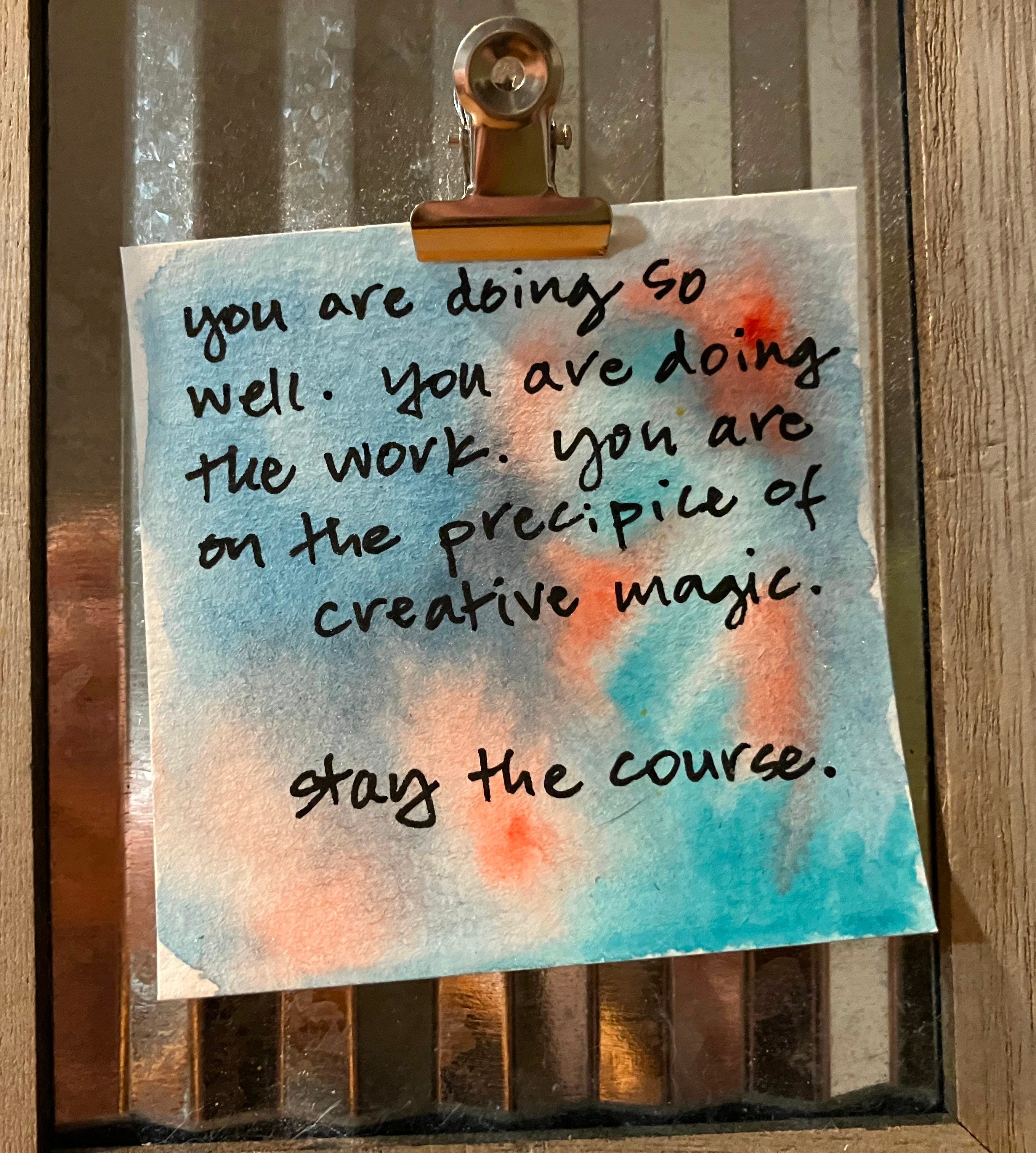
I may not share the actual writing that I put down for these prompts next time, but I will share my process and what I learned. Feel free to do the same. Type at you in two weeks! Loralee P.S. As Amie McNee would say…
I learned so much from this, thank you! Your description of your process is so clear and helpful. And it highlights the power of persistence and focus on the long game. As always, you inspire me!