
Two Resources and One Question That Can Help You Create

When I was in my fifth and final year of undergraduate studies, I worked with a professor who encouraged me to study with her in my graduate school years. One invaluable tool she gave to me, which sounds simple enough, is a book list. In the early 90’s, where I was living in Maine, cloth-bound lined books were in every stationery and gift store and they beckoned the buyer in with promises of creative possibility—I threw my money at one and began writing down any and all areas of interest I could find. I began writing down articles and books I wanted to focus on for my continued studies and this helped me know what my next area of research was going to be. It was helpful for me as a student, but it was actually invaluable to me as a writer.
I remember the stiff, thick paper and the cover was redolent with hydrangeas in blues, pinks and purples. I carried that book with me everywhere, scribbling in article titles, library call numbers, book titles that I would bring into every used book store I could find, always on the hunt. That 80-page book lasted me through the rest of my undergraduate studies when I was reading tons of poetry in order to write my own, two years of grad school, and two years after grad school.
Thirty years later I use a file on my computer, but my intent is still the same; it’s a great resource for me to mine as I look for a new project. I tend to fill it with nonfiction books, memoirs, articles or authors. Here’s a sample:
• The Tree Forager
• Corporeal Writing/Lidia Yuknavitch
• Sand Talk: How indigenous thinking can save the world/ Yunkaporta
• see no stranger/ Valarie Kaur
• any bell hooks book (bone black)
• a beautiful question (530.01 WIL)
• journal of radical permission/ adreienne maree brown
• discourse on colonialism/ cesaire
• wretched of the earth/ fanon
Currently I’m reading Becoming Earth: How Our Planet Came to Life, Ferris Jabr; Entangled Life: How Fungi Make Our Worlds, Change Our Minds & Shape Our Futures, Merlin Sheldrake; When Women Were Dragons, Kelly Barnhill; Marbles on the Floor: How to Assemble a Book of Poems, Giragosian & Konchan, eds.; and The Mabinogion. * Expect to see more nature poems, fungi poems and myth from me!
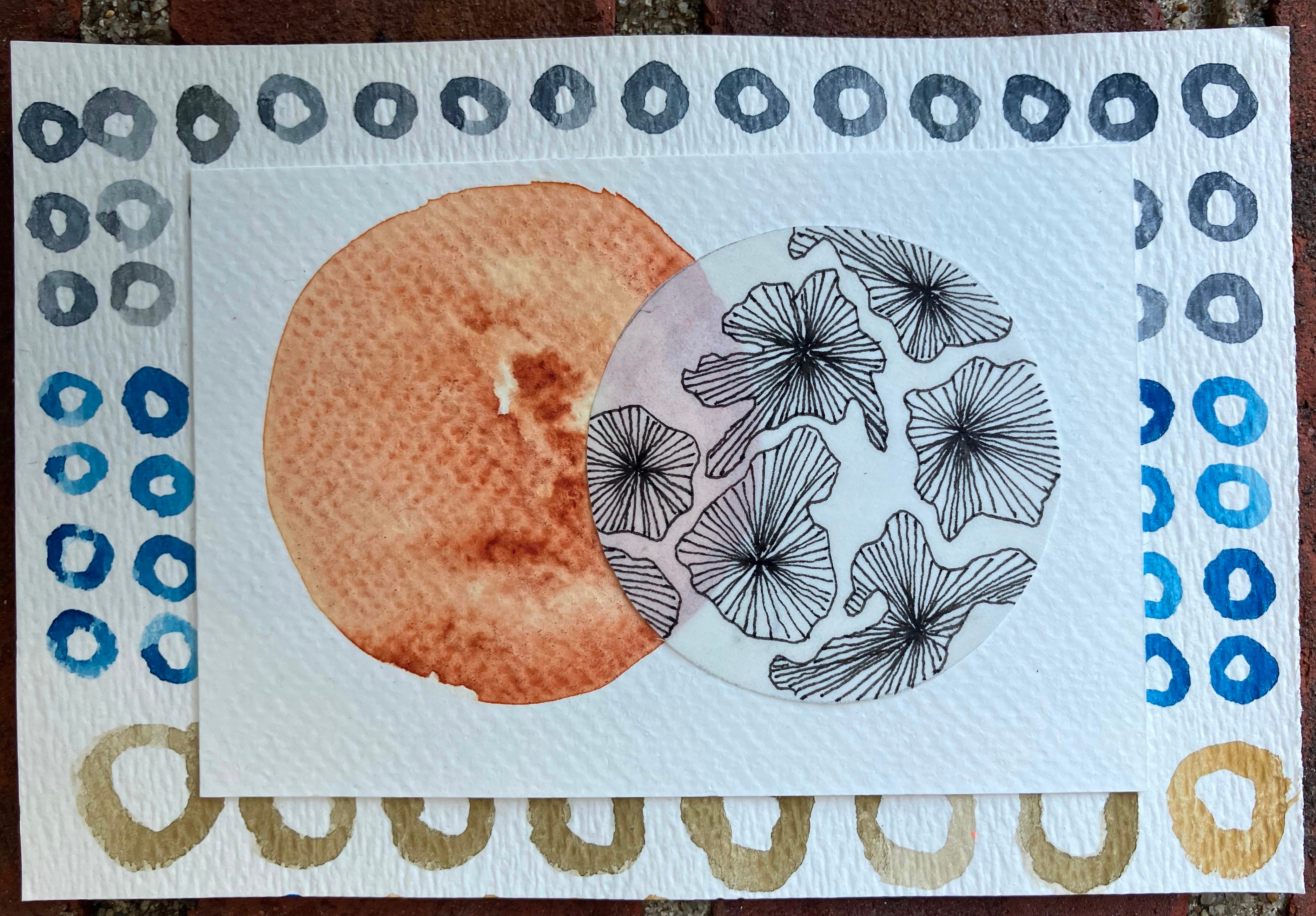
The second tool I use consistently as a writer and artist is a variation of a book list—a research list with abbreviated notes. So many times, I stop myself from creating due to old messages, overwhelm or boredom (which is really just a form of old messages). With a research list I don’t have to give in to those feelings—I simply ignite my curiosity and I can be creating again. Currently my list has information about bees, stars, bones, snippets of poetic phrasing that came to me, spiders, the poet Anne Carson, and information about Antediluvian civilizations.
S. Fey, the poet, mentioned in a recent craft chat on YouTube, that as a writer one is either a cat or a bull. The cat naps in the sunlight, looks up and notices a fly buzzing by. Struck by its proximity, it bats at the fly. The bull wakes up and begins working in the field from sunrise until sunset. I am both a cat and a bull; sometimes an idea grabs me and I run with it. Most times, however, I am a bull, sitting at my desk or in a café or outside, deriving meaning and asking questions and writing or drawing about it all—even if it is only for an hour a day. Really, ideas are all around us, all of the time, but unless I make an effort to organize them, they are rendered pretty useless to me.
Lastly, one very important question I find invaluable is to personify my project—whether it is an individual poem, a poetry manuscript, a series of watercolors, or a sketchbook. Ask your project what it needs. What do you, as a series of drawings, need from me? What do you, as a chapbook, need from me? Sit with the question and then free write the answers for a while. For my “Neolithic Imaginings” chapbook, as I wrestled with my Stonehenge poem, I asked it what it needed—the answer was it needed to be able to have musicality in the body of the poem; the bluestones of the henge were not well represented yet. So, I tried a villanelle form; it was fine as a poem, but it wasn’t filled with musicality like I had hoped. However, it did give me two really nice phrases/lines that I was able to incorporate into the original poem that rendered it a bit more lyrical.
Sometimes you become stuck with where to begin. Sometimes you get stuck when you are in the process. Wherever you find yourself struggling, see if these three tools can help you to move forward. They aren’t a cure-all, but they are handy tools to have in your crafting basket.
* While I currently am reading those books, there are the books I am always referring to which help me as a writer:
• Hild by Nicola Griffith
• Draw Yourself Calm: Draw Slow, Stress Less by Amy Maricle
• Braiding Sweetgrass: Indigenous Wisdom, Scientific Knowledge, and the Teachings of Plants by Robin Wall Kimmerer
• How to be an Explorer of the World: Portable Life Museum by Keri Smith
• Evolutions: Fifteen Myths that Explain Our World by Oren Harman
• Inanna Queen of Heaven and Earth: Her Stories and Hymns from Sumer
• The Flowering Wand: Rewilding the Sacred Masculine by Sophie Strand
• Botany in a Day: The Patterns Method of Plant Identification by Thomas J. Elpel
I would love to hear from you about the tools and/or books you use to help you create. Feel free to begin a list in the comments for us to use as a resource for when we are stuck in our creative paths.